Follicular Density Mapping Explained: What FU/cm² Actually Measures
Follicular density is the single most important number in hair loss diagnosis.
Follicular Density Mapping Explained: What FU/cm² Actually Measures
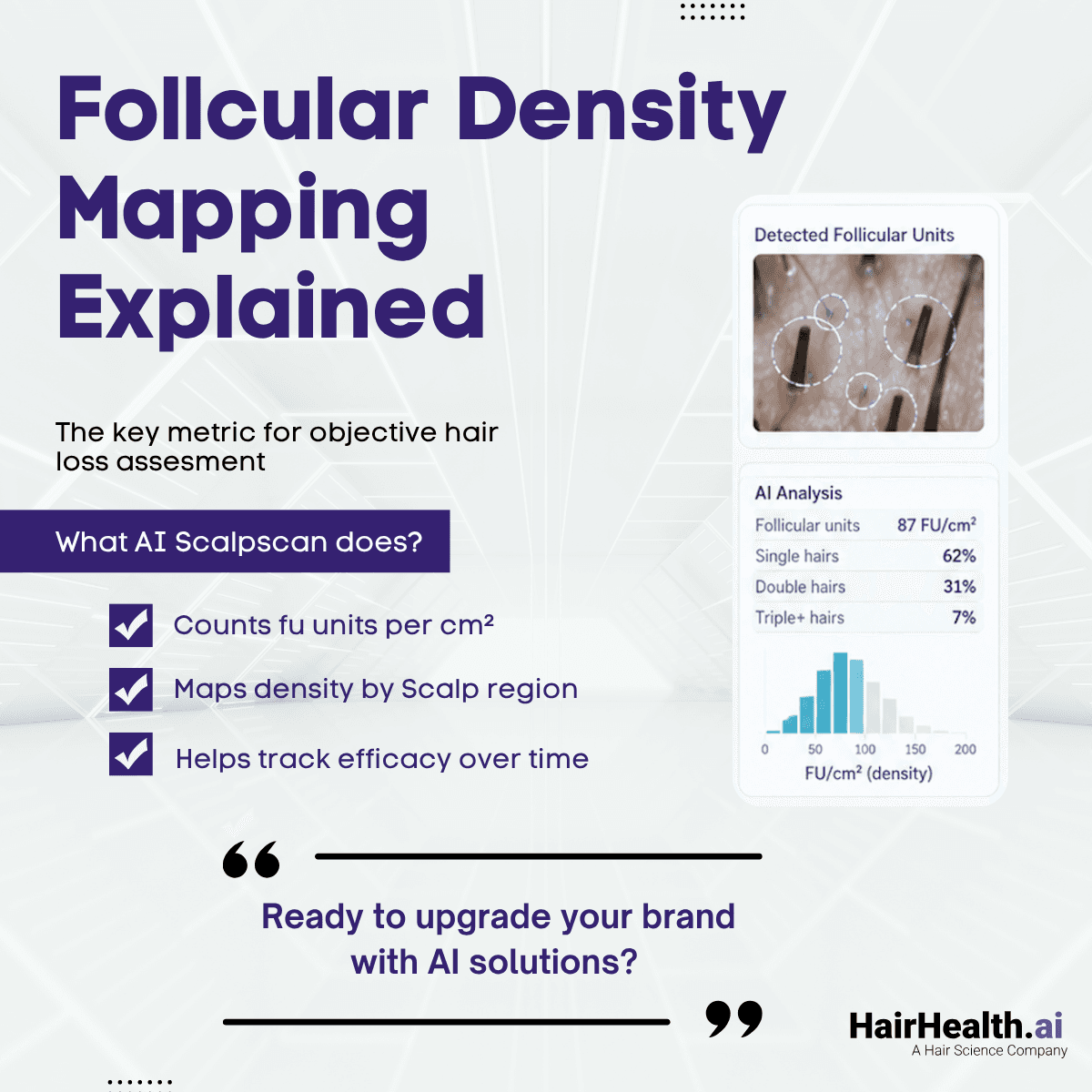
Quick answer: Follicular density mapping measures the number of follicular units per square centimeter of scalp (FU/cm²) across different scalp regions, giving an objective picture of where and how much hair loss has occurred. It's the single most widely used quantitative metric in hair loss diagnosis, because unlike a visual impression, a density number is directly comparable across time — making it the foundation for tracking whether a treatment is actually working.
Ask a dermatologist, trichologist, or hair transplant surgeon what the single most important number in hair loss assessment is, and most will land on the same answer: follicular density. It's the metric that turns "your hair looks thinner" into something measurable, trackable, and comparable — which is exactly why it sits at the center of most AI hair diagnosis tools, including AI ScalpScan.
This post covers what follicular density actually is, how FU/cm² is measured, why regional mapping matters more than a single scalp-wide average, and what the number can and can't tell you on its own.
What a Follicular Unit Actually Is
A follicular unit (FU) is a small, naturally occurring cluster of hair follicles that grow together from a single point on the scalp — typically one to four individual hairs sharing a follicular opening, along with associated sebaceous glands and small muscles. It's the natural anatomical grouping hair grows in, which is why it's used as the counting unit rather than counting individual hair strands.
This matters because a follicular unit can contain a different number of hairs at different stages of hair loss — a unit that once produced three healthy terminal hairs might, as miniaturization progresses, produce fewer hairs or thinner vellus hairs instead, even before the unit disappears entirely. Density alone doesn't capture that shift, which is why density is almost always measured alongside other parameters like terminal-to-vellus ratio and average hair shaft thickness — not as a single number in isolation.
What FU/cm² Means and How It's Measured
FU/cm² is simply the count of follicular units within a defined one-square-centimeter area of scalp. In manual trichoscopy, this has traditionally involved clipping a small area of hair, capturing a magnified image, and counting units by eye or with basic image analysis software — a process that's accurate but slow, and dependent on the skill and consistency of whoever is doing the counting.
AI-based density mapping automates this counting process using computer vision trained to identify individual follicular units in a magnified scalp image, producing a density figure in seconds rather than minutes, and — critically — doing so the same way every time, removing a meaningful source of variability that exists when different people (or the same person on different days) do the counting manually.
Why Regional Mapping Matters More Than a Single Average
A single scalp-wide density average can be misleading. Hair loss in androgenetic alopecia typically doesn't progress evenly — the crown and frontal hairline are often affected well before the occipital (back of the head) region, which is part of why the back of the scalp is typically used as the donor area in hair transplant surgery.
This is why proper density assessment maps multiple defined regions separately — typically frontal, mid-scalp, vertex/crown, and occipital — rather than reporting one number for the whole scalp. A patient with a low crown density but a healthy, stable occipital density has a meaningfully different picture than one with uniformly low density everywhere, and the regional map is what reveals that distinction. It also matters directly for surgical planning, where donor area density is one of the key factors determining how many grafts can realistically be harvested.
Why Consistency Matters More Than the Raw Number
Here's the part that's easy to overlook: a single density reading, on its own, tells you where someone stands today. It doesn't tell you whether they're improving, stable, or declining — for that, you need at least two readings taken under genuinely comparable conditions, at the same scalp location, ideally months apart.
This is where measurement consistency becomes more important than raw accuracy. If two readings of the same scalp spot, taken under slightly different lighting, angle, or magnification, produce meaningfully different density numbers purely due to measurement noise rather than real biological change, the resulting trend line is unreliable — and can mislead a patient or clinician into thinking a treatment is failing (or working) when the real cause is inconsistent capture conditions.
This is why same-spot registration — a system for reliably returning to the exact same scalp location for every follow-up measurement — matters as much as the underlying density algorithm itself. A highly accurate single-point measurement is far less useful than a moderately accurate but highly consistent one, when the actual clinical question is "has this changed."
What Density Doesn't Tell You
Density mapping is one input into a hair loss assessment, not the whole picture. It doesn't, on its own, tell you the cause of hair loss (androgenetic, telogen effluvium, alopecia areata, and other causes can all reduce density, but require different diagnostic approaches to distinguish). It also doesn't capture scalp condition — inflammation, scarring, or other dermatological findings that a clinician would assess separately. A complete hair loss diagnosis combines density mapping with shaft thickness, terminal-to-vellus ratio, scalp condition assessment, and clinical history — not density in isolation.
FAQs
What is a good follicular density for hair? Healthy scalp density is typically in the range of 75- 120 follicular units per cm² in unaffected areas, though this varies by individual, hair type, and scalp region. What matters more clinically than hitting a specific number is the relative density across regions and any change over time.
How is follicular density measured without shaving the scalp? Modern trichoscopy and AI-assisted imaging can typically assess follicular density from unclipped hair using magnified imaging and computer vision analysis, though some methods still use small clipped areas for higher measurement precision, particularly for detailed research applications.
Why does the same scalp spot need to be used for every measurement? Follicular density varies naturally between different scalp regions, so comparing readings from different locations over time can create a false impression of change. Measuring the exact same spot consistently isolates real biological change from location variability.
Can AI measure follicular density as accurately as a dermatologist? This depends heavily on how the specific AI model was trained and validated — a well-trained model checked against real clinical data can match manual counting closely, but the honest answer is that accuracy varies significantly by tool, which is why it's worth asking any vendor how their model was validated rather than accepting an accuracy claim without context.
Is follicular density the same as hair density? They're related but distinct. Hair density typically refers to the number of individual hair strands per unit area, while follicular density refers to the number of follicular units — which can each contain multiple hairs. A unit-based measurement is generally considered more clinically meaningful, since units are the actual biological structure hair loss affects.